
Last Updated: 31 October 2026
Quick Summary
Choose a family card game by the youngest player’s age, your group size and the kind of decisions your children enjoy. For repeat play, look for changing card combinations, player choices, missions or difficulty settings. This guide compares Quesbo’s own games using their current product descriptions; it is not an independent ranking or a claim that every child will prefer the same game.
- Cooperative games such as Galley Dash give players a shared goal and a shared outcome.
- Voyage’s Quick game takes approximately 10–20 minutes; Magic Illusions is listed at 20–30 minutes. Allow extra time to learn the rules.
- Compare the skills actually used in play, such as calculation, observation, planning or discussion.
- Match games to your child's age, strengths, and play style rather than buying based on appearance alone
- Voyage offers solo and two-player modes; check the group size before buying.
Table of Contents
- Why Family Games Kids Actually Enjoy Make All the Difference
-
Compare 10 Quesbo Family Card Games
- Galley Dash: Teamwork Under Pressure
- Tiny Empire: Deduction Meets Mental Maths
- The Alchemist's Numbers: Flexible Thinking with Numbers
- Voyage: Solo or Two-Player Adventure
- Trail Quest World Expeditions: Fast-Paced Exploration
- Crumbly: Shape Puzzles and Character Powers
- London Clue Dash: Planning and Logic
- Around the World in 80 Gusts: Strategic Decision-Making
- Magic Illusions: Observation and Memory
- HOPABOUT London: Route Planning and Collecting
- Cooperative Board Games for Kids That Build Confidence
- Quick Family Games for Busy Evenings
- Educational Board Games for Children: Learning Through Play
- How to Choose Games That Keep Kids Engaged
- Conclusion: Start Your Game Night Adventure
- Frequently Asked Questions
- What changes between plays?
- Five-play family game diary
Why Family Games Kids Actually Enjoy Make All the Difference
A game is worth returning to when the players enjoy its decisions as well as its theme. Some families want a shared puzzle; others prefer competing, taking risks or discovering a different route.
The challenge isn't finding games. It's finding games that hold attention without screens, teach something real without feeling like homework, and work across different ages.
Family games kids actually enjoy share a common trait: they balance fun with meaningful choice. Kids aren't just rolling dice and moving pieces.
Below are ten Quesbo card games to compare, followed by six examples of replay features and a five-play diary. Recommendations are based on the published game details, with missing playing times marked clearly.
Compare 10 Quesbo Family Card Games
The following selection covers different themes and styles. It does not rank games from other publishers; check each linked edition for its current contents and availability.
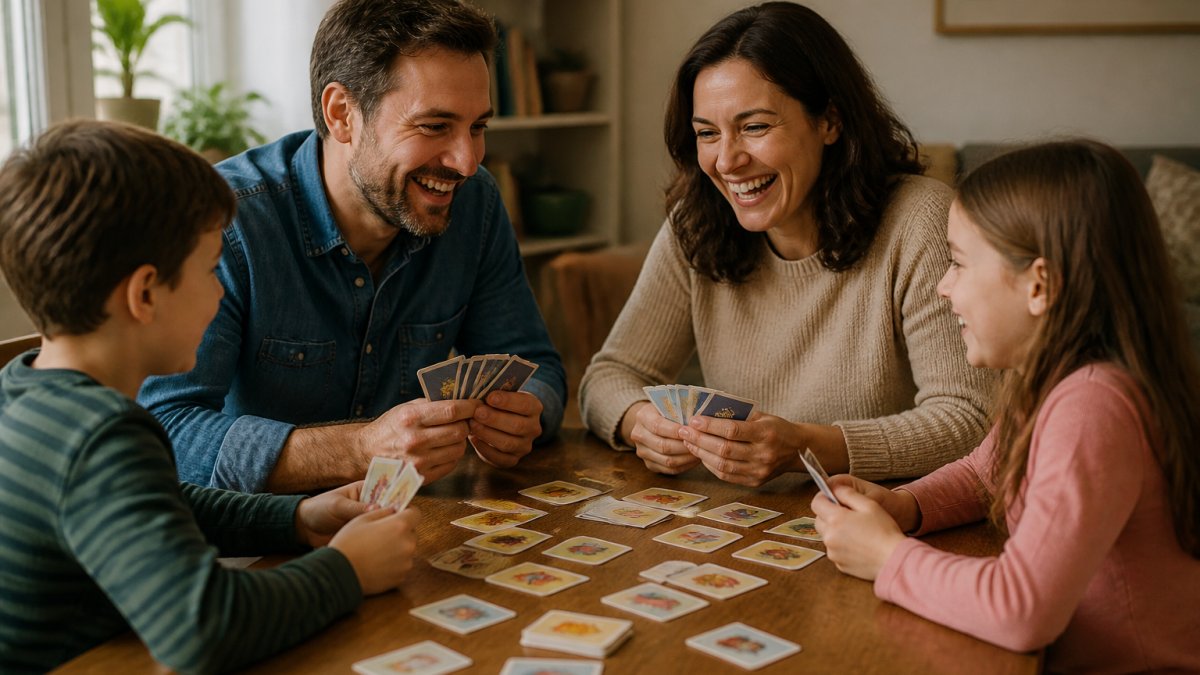
Galley Dash: Teamwork Under Pressure
Galley Dash puts your family in charge of an aircraft galley. You are the cabin crew working together to prepare and serve meals before the flight lands.
You choose what to cook, manage limited oven space, and adjust when turbulence disrupts your plans. Players aged 8 and up grasp the basic flow, but tactical choices keep adults engaged.
Why consider it: The shared goal gives players opportunities to explain plans, listen to each other and agree on their next move. The group still needs to manage the challenge together.
Galley Dash! - Cooperative Family Cooking Card Game | Ages 8+ Check current price and availability

Tiny Empire: Deduction Meets Mental Maths
Tiny Empire asks players to run miniature shops and crack customer clues.
It practises deduction, observation, and mental arithmetic without drilling. Kids spot patterns and do real maths because it serves the game.
Why it works: The deduction element feels like solving a mystery.
Tiny Empire - Family Deduction & Quick Maths Card Game | Ages 8+ Check current price and availability

The Alchemist's Numbers: Flexible Thinking with Numbers
This game transforms numbers into creatures, potions, and relics.
The standard mode uses addition and subtraction. Advanced mode introduces multiplication and division. No speed pressure. No shouting.
Why it works: The Echo mechanic encourages generosity and planning. Flexible thinking with numbers, using cards in different ways, builds mathematical confidence.
The Alchemist's Numbers - Family Maths Card Game | Ages 10+ Check current price and availability

Voyage: Solo or Two-Player Adventure
Voyage works for one player or two.
Solo mode offers an option for one player; two-player mode adds a rival’s travel decisions. Younger players may need help learning the rules.
Why consider it: The travel theme, destination choices and solo difficulty settings offer several ways to approach a game.
Voyage™ (Standard Edition) - Travel Card Game for Kids, Teens & Families | Ages 8+ Check current price and availability
Trail Quest World Expeditions: Fast-Paced Exploration
Trail Quest First Edition is a travel card game for 2–4 players aged 8+. Players collect gear, tackle challenges and work towards destinations. Its current product page does not specify a playing time.
Draw cards, play cards, overcome obstacles, reach destinations. Special cards boost your progress or slow rivals.
Why consider it: The exploration theme gives curious players a setting for planning their next move. Check the edition: the Standard Edition is a separate product with different age guidance.
Trail Quest® World Expeditions Kids Travel Strategy Card Game Ages 8+ (First Edition) Check current price and availability
Crumbly: Shape Puzzles and Character Powers
Crumbly is set in Scotland. You gather ingredients, arrange biscuit shapes in your tray, and complete orders.
The shape puzzles are genuinely clever. You arrange fingers, rounds, petticoat tails, and thistles in specific patterns.
Why it works: Shape puzzles develop spatial reasoning without being abstract. The character powers mean every player has a unique advantage.
Crumbly™ - The Great Scottish Shortbread Scramble | Family Card Game Check current price and availability
London Clue Dash: Planning and Logic
London Clue Dash puts players in a race around a card-game version of London.
The clue-solving mechanic is satisfying: you match symbols and decode patterns, while City Events disrupt plans and keep everyone thinking.
Why it works: The planning element appeals to strategic thinkers. The landmark theme teaches geography naturally.
London Clue Dash | London Family Card Game - Quesbo Check current price and availability
Around the World in 80 Gusts: Strategic Decision-Making
In this game, you captain a hot-air balloon around the world.
Around the World in 80 Gusts – Family Strategy Card Game →
The route spans London to Cairo, Jaipur, Tokyo, Honolulu, and San Francisco, with a shorter Pacific Challenge option for learning.
Why it works: The weather and resource management create real tension. Solving constellation puzzles adds a knowledge element.
Around the World in 80 Gusts - Family Strategy Card Game Check current price and availability
Magic Illusions: Observation and Memory
Magic Illusions presents optical illusions with multiple interpretations. A fox might also be a crown or a mountain.
The game combines observation, memory, and pattern recognition. No speed pressure. You can peek at answers before deciding.
Why it works: Observation skills develop naturally through play. The multiple interpretations spark conversation.
Magic Illusions - Optical Illusion Family Card Game | Ages 10+ Check current price and availability
HOPABOUT London: Route Planning and Collecting
HOPABOUT London uses Journey cards with shapes and angles to navigate a fictional Tube network.
The shape and angle matching develops spatial reasoning. The collecting mechanic appeals to children who like completing sets.
Why it works: Route planning teaches logical thinking. The landmark discovery makes geography memorable.
HOPABOUT™ London - Family Tube Adventure Card Game, Ages 10+ Check current price and availability
| Game | Ages | Players | Length | Best For |
|---|---|---|---|---|
| Galley Dash | 8+ | 2-4 | 25-35 min | Teamwork and cooperation |
| Tiny Empire | 8+ | 2-5 | 6 customer rounds; minutes not specified | Maths and deduction |
| The Alchemist's Numbers | 10+ | 2-4 | 20-30 min | Flexible number thinking |
| Voyage | 8+ | 1-2 | Quick: 10–20 min; Extended: 20–30 min | Solo or partner play |
| Trail Quest | 8+ | 2-4 | Not specified | Quick exploration |
| Crumbly | 10+ | 2-5 | 25-40 min | Shape puzzles |
| London Clue Dash | 10+ | 2-4 | Not specified | Planning and logic |
| Around the World in 80 Gusts | 10+ | 2-5 | Varies | Strategy and adventure |
| Magic Illusions | 10+ | 2-5 | 20-30 min | Observation and memory |
| HOPABOUT London | 10+ | 2-4 | 8 rounds | Route planning |
What makes a game worth playing again?
Replayability means having reasons to return: different card combinations, decisions, routes, missions or difficulty levels. There is no single best game for every child. Match the age, group size and play style first, then ask what changes on the next play.
These six examples explain mechanisms in Quesbo’s published product details. They are not independent test results or a promise that children will always ask to play again.
| Game | Age & group | Playing time | Reasons to try another approach |
|---|---|---|---|
| Voyage — Standard Edition | 8+ · 1–2 players | Quick: approximately 10–20 minutes; Extended: 20–30 minutes | Thirty destinations, choices between dependable Flights and risky Standby reveals, Quick/Extended formats and three solo difficulty settings offer different decisions and challenge levels. |
| Galley Dash! | 8+ · 2–4 players | Approximately 25–35 minutes | The crew decides what to cook, how to allocate limited oven space and when to deliver meals, then adapts to turbulence and service interruptions. |
| Wild Rescue: Safari Station | 10+ · 2–6 players | Not stated on the current product page | Players share rescue supplies and coordinate actions while changing weather and hazards affect rescue priorities. The team succeeds or loses together. |
| CAVERN: The Shifting Depths | 10+ · 1–4 players | Not stated on the current product page | Twenty-four expeditions across four regions, three move-allowance settings and an unlimited-move Practice mode provide a defined set of puzzles and adjustable challenge. |
| FICELLES! — Pull the Strings | 8+ · 2–4 players | 15–20 minutes | Secret movement choices alter a shared puppet stage. Each player has separate scenes to complete, so another player’s move can create or undo an opportunity. |
| JUST ONE STOP | 8+ · 2–6 players | 15–20 minutes | Everyone chooses Stay or Leave before each reveal; leaving banks postcards while staying risks another mishap. New reveals and other players’ decisions change when it is sensible to stop. |
For a shared goal, compare Galley Dash, Wild Rescue and CAVERN. For a shorter competitive game, compare FICELLES! and JUST ONE STOP. Voyage supports solo or two-player travel decisions. CAVERN has a finite set of 24 expeditions; knowing a solution can reduce its novelty, while the different move allowances provide another challenge.
Does a replayable game need expansions?
Look first at what the base game contains. Variable decisions, several missions or adjustable difficulty can provide reasons to play again without an expansion. The examples above describe features in the listed games, rather than additional purchases. Check the current edition and contents before buying.
What should I check when comparing games made in the UK?
Check the manufacturing information for the exact game and edition, alongside age, player count, rules and delivery. A publisher’s address and a product’s manufacturing location are different facts. Our physical games collection explains Quesbo’s production and dispatch information; contact us if you need details about a particular component or edition.
Cooperative Board Games for Kids That Build Confidence
Many families struggle with competitive games. Someone loses, feelings get hurt, and the evening ends badly. Cooperative games flip that dynamic.
Galley Dash! is cooperative for 2–4 players aged 8+. For 2–6 players aged 10+, Wild Rescue: Safari Station also gives the group a shared goal. The Alchemist’s Numbers is competitive: its shared Echo can help another player, but the highest star total wins.
A shared goal changes the focus from beating another player to solving a problem together. It does not remove all pressure, and families may still need to make space for everyone’s ideas.
Quick Family Games for Busy Evenings
For a shorter session, Voyage’s Quick game is listed at approximately 10–20 minutes for one or two players. Magic Illusions is listed at 20–30 minutes for 2–5 players aged 10+. Leave extra time for setup and learning the rules.
Trail Quest First Edition is listed for 2–4 players aged 8+, but its current product page does not give a playing-time estimate. Voyage offers solo play as well as two-player play; younger players may still need help learning its rules.
Educational Board Games for Children: Learning Through Play
The best educational games aim to integrate learning seamlessly. The learning happens because the game requires it.
Tiny Empire teaches maths because you need to calculate change correctly to win.
This approach works because kids aren't drilling. They're playing.
Quesbo games are designed with this principle. Each game includes an educational element, but fun comes first. The discovery happens naturally.
How to Choose Games That Keep Kids Engaged
The question parents often ask is: "How do I know my child will actually play this instead of letting it gather dust?"
Start with the age range.
Consider your child's strengths. A puzzle-lover will take to Magic Illusions or Crumbly; a competitive child who needs to learn cooperation gets teamwork through Galley Dash's shared goal rather than a lecture.
Think about play style: a shared goal, a competitive puzzle, or a shorter session can lead to different choices. Use the stated playing times rather than assuming a small box means a short game.
Check the player count for everyone who wants to take part. Voyage supports one or two players; choose a different game for a larger group, such as Galley Dash for 2–4 players or Magic Illusions for 2–5.
Test it yourself first if possible, you'll spot whether the rules make sense and the theme appeals. You can often watch gameplay videos.
Conclusion: Start Your Game Night Adventure
Family games kids actually enjoy don't just fill time. They create moments. These moments can build connection and confidence.
Start with one game that matches your family's style. Galley Dash for cooperation, Tiny Empire for maths, Voyage for independence. Add another when you're ready. Over time, you'll build a collection that works across different moods and ages.
Will your family want to play again? Try a five-play diary
Use this with any game you already own. Copy the table into a notebook or print this section. Play when the family wants to, rather than requiring five sessions. Record what happened without names or other personal details.
| Play | Setup + play time | What changed or what did we try? | Where was help needed? | Would we choose it again? Why? |
|---|---|---|---|---|
| 1 | ________ | ________ | ________ | ________ |
| 2 | ________ | ________ | ________ | ________ |
| 3 | ________ | ________ | ________ | ________ |
| 4 | ________ | ________ | ________ | ________ |
| 5 | ________ | ________ | ________ | ________ |
After each session, ask: “What would you try differently?” and “Would you choose this again, or something else?” A game your family freely returns to can be a better fit than one with a long feature list. This is a family reflection tool, not a scientific test or a published rating.
For more help choosing a learning activity, read how to choose educational games around your child’s interests, or browse Quesbo’s physical games.
Frequently Asked Questions
What makes family games kids actually enjoy different from other board games?
Useful features to compare include meaningful choices, changing setups or missions, manageable rules and a theme your family enjoys. Match the age and player count first, then read how the game changes between plays. Preferences vary, so a short family play diary can help you see what your own children choose to return to.
How do cooperative board games for kids help with confidence and problem-solving?
Cooperative games give players a shared goal rather than individual winners. In Galley Dash, the crew discusses plans and adapts to service interruptions. Give each player space to contribute; a shared outcome does not guarantee that every child will enjoy every session.
Which quick family games work best when you only have 20-30 minutes?
Voyage’s Quick mode is listed at approximately 10–20 minutes, while Magic Illusions is 20–30 minutes. Voyage is for 1–2 players aged 8+; Magic Illusions is for 2–5 players aged 10+. Tiny Empire is played over six customer rounds, and its product page does not currently specify minutes. Check the exact edition and allow time to learn the rules.
How do educational board games for children teach maths and language skills without feeling like schoolwork?
A game can make a skill part of its decisions. Tiny Empire uses customer clues, payment and change. The Alchemist’s Numbers uses addition and subtraction in Family mode, with multiplication and division in Advanced mode. These are opportunities to practise; they do not establish a guaranteed learning outcome.
Can family games work across different ages, or do I need separate games for each child?
Start with the youngest player’s recommended age and check reading confidence, calculation and comfort with the decisions. The Alchemist’s Numbers is recommended for ages 10+ and has Family and Advanced modes. Galley Dash is 8+; Crumbly is 10+. An adult may need to explain cards and rules. Optional modes do not automatically make a game suitable below its stated age.
The shift from "What shall we do?" to "Let's play again!" happens when games respect children's thinking and deliver genuine fun. Every game in this guide does that. Big adventures and clever play are waiting. Your next game night starts here with Quesbo.

