

Table of Contents
- Why Educational Games That Feel Fun Actually Work
- Fun Educational Games for Children: What Makes Them Different
- Maths Board Games for Children That Build Confidence
- Educational Board Games for Families That Bring People Together
- Screen-Free Educational Games: Why They Matter
- How to Choose an Educational Game Your Child Will Actually Play
- Keeping Educational Games Fresh and Engaging
- Frequently Asked Questions
Last Updated: 19 October 2026
Why Educational Games That Feel Fun Actually Work
The moment a child realises they're learning without noticing it, something shifts. They stop seeing the activity as a chore and start seeing it as an adventure. That's where educational games that feel fun make their mark. Rather than drilling facts into reluctant minds, these games wrap learning inside genuine play, strategy, discovery, and friendly competition all rolled into one.
What makes this approach work is straightforward: engagement drives retention. When a child is focused on winning a game or solving a puzzle, they're naturally practising the skills embedded within it. The maths isn't separate from the fun. It's woven into every decision they make. At Quesbo, we've designed our games around this exact principle, fun comes first, with learning built into the mechanics themselves.
The research on screen-free play supports this. Children who engage with hands-on, interactive games show stronger problem-solving skills and better ability to focus than those who passively consume content. Educational games that feel fun do more than teach; they build confidence. A child who masters a challenging round of a strategy game walks away feeling capable, not exhausted.
Fun Educational Games for Children: What Makes Them Different
The gap between a game that teaches and a game that children actually want to play is enormous. Most educational games fail because they prioritise the learning objective over the experience. They feel like homework with dice. The games that succeed, the ones children ask to play again, flip that order entirely.
What separates a genuinely fun educational game from a mediocre one comes down to a few core elements. First, there's choice. Games that let children decide their own path, try different strategies, and recover from mistakes feel less prescriptive. Second, there's pacing.
Educational games that feel fun also build in multiple ways to succeed. A child who's strong at pattern recognition might excel through observation, while another who's quick with mental maths might take a different route. This flexibility means children of varying abilities can play together without anyone feeling left behind or held back.
Maths Board Games for Children That Build Confidence
Maths board games for children work best when they make numbers feel tangible. Abstract calculations are intimidating. But when a child can see counters, arrange groups, or physically build numbers, maths becomes something they can control and experiment with.
The strongest maths games follow a simple pattern: present a challenge, let the child explore solutions at their own pace, and reward correct thinking without punishing mistakes harshly. This builds confidence because failure feels temporary and fixable, not like proof of inability.
Quick maths with deduction
Games that combine quick mental arithmetic with logical deduction keep children sharp without making them anxious. The best ones include difficulty levels so a child can start where they feel comfortable and progress naturally. Tiny Empire works this way, players study customer clues to identify hidden shopping rules, then calculate payment and change. The maths isn't separate from the puzzle; it's the tool that solves it. A child who struggles with mental arithmetic can work through it at their own pace. One who's confident can move faster and tackle harder customer rounds.
Quick maths games also benefit from clear, immediate feedback. When a child makes a calculation, they know right away if it's correct. This instant loop keeps them engaged and helps them learn from mistakes in real time rather than discovering errors later.
Number challenges at your own pace
The most effective maths board games for children let them control the difficulty and speed. Number Workshop offers this through three distinct levels, Easy, Medium, and Difficult, so a child aged 6 can start gently with early number building and small sums, while a 10-year-old can jump straight to hundreds and fractions. All three levels live in one purchase, and children can switch between them as they grow or as their confidence shifts.

Games structured this way remove the pressure that often stalls learning. A child who feels they're "not a maths person" can start with accessible challenges and build up gradually. Success breeds confidence, and confidence breeds willingness to try harder problems.
| Difficulty Level | Focus Areas | Approximate Age Guide |
|---|---|---|
| Easy | Number building, small sums, sharing, fractions | 6-8 |
| Medium | Larger numbers, varied calculations, fractions | 8-10 |
| Difficult | Hundreds, demanding calculations, fraction quantities | 10-12 |
Educational Board Games for Families That Bring People Together
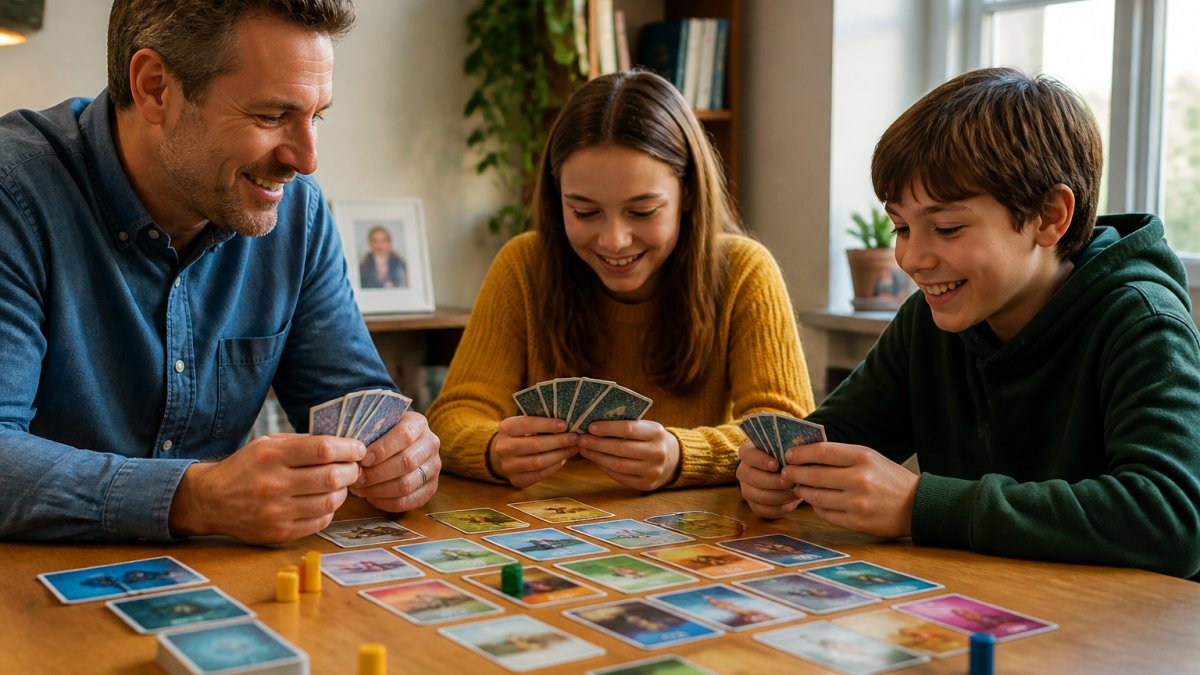
Educational board games for families serve a purpose beyond learning, they create shared moments. Family game nights where everyone's actually engaged, laughing, and thinking together are rare enough to be worth protecting. The games that achieve this balance learning with genuine fun.
The strongest family educational games include rules that work across different ages and skill levels. A 7-year-old and a 14-year-old can play the same game without one dominating or the other struggling. This is harder to achieve than it sounds. It requires careful game design that rewards different kinds of thinking.
Games that work across different ages
Multi-age games succeed when they have built-in flexibility. The Alchemist's Numbers does this through two rule sets. Family mode uses addition and subtraction, making it accessible to younger players. Advanced mode introduces multiplication and division for older children. Everyone plays the same game, but at the level that challenges them. No one feels like they're playing a simplified version while others play the "real" game.

Another approach is games where different players can win through different strengths. Some players might excel at pattern recognition, others at quick calculation, others at strategic planning. When a game rewards multiple types of thinking, it stays engaging for a wider range of ages and abilities.
Language learning through play
Language learning games work best when they focus on practical vocabulary and real-world situations rather than isolated words. OH LÀ LÀ! and VAMOS! teach French and Spanish through everyday scenarios, ordering food, finding directions, greeting people, so children learn phrases they might actually use. The games include pronunciation cues and audio, so children hear native speakers and can practise saying words aloud without fear of judgment.
Educational board games for families that teach languages also benefit from optional play. If a child isn't ready to speak aloud, they don't have to. Help is always welcome, and accuracy is never scored. This removes the pressure that often stops children from engaging with language learning.
Number Workshop — 180 Interactive Maths Challenges →
Screen-Free Educational Games: Why They Matter
Screen-free educational games offer something digital tools struggle to replicate: genuine social presence. When children play together around a table, they're reading faces, negotiating rules, celebrating together, and managing disappointment in real time. These aren't side effects of the game, they're central to the experience.
The benefits run deeper than socialising. Hands-on games develop fine motor skills. Turning cards, moving pieces, and handling game components builds dexterity in ways screens don't. Children also develop patience and focus differently. A screen game can hold attention through constant stimulation. A board game holds attention through engagement and the need to think. That's a different kind of mental work.
Screen-free educational games also create space for conversation. During a game, children talk through their thinking, ask questions, and explain their reasoning. Parents or teachers can listen, ask clarifying questions, and gently guide without it feeling like instruction. Learning happens through dialogue, not broadcast.
How to Choose an Educational Game Your Child Will Actually Play
The gap between a game that looks good on paper and one your child will actually reach for is worth paying attention to. A beautiful, well-designed game that sits on the shelf teaches nothing. The right choice depends on knowing your child's interests, their current skill level, and what kind of play they actually enjoy.
Start with interest. If your child loves animals, a game built around animals will pull them in faster than one built around abstract concepts. If they're competitive, they'll engage with games where winning feels achievable and rewarding. If they prefer cooperation, competitive games will frustrate them.
Next, consider difficulty. A game that's too hard discourages. One that's too easy bores. Number Workshop lets you choose the level. Tiny Empire offers three customer difficulty levels.

Finally, think about the kind of play your child gravitates toward. Do they like strategy? Pattern recognition? Speed? Social play? Quick rounds or longer games? The best educational games for your child are the ones that match their natural play style, not the ones that force them into a style that doesn't suit them.
Keeping Educational Games Fresh and Engaging
Even the best game loses appeal if it's played the same way every time. The games that stay engaging over months or years are the ones that offer enough depth to reveal new layers with repeated play.
One way to keep games fresh is to introduce house rules or variations. Once your child has mastered the basic game, try playing with different objectives.
Another approach is to rotate games. Instead of playing one game every night, have a collection and let your child choose. This prevents fatigue and keeps each game feeling special.
Finally, involve your child in the learning process. Ask them what they noticed about winning or losing. What strategy worked? What would they try differently next time?
The right educational games that feel fun don't require screens, expensive subscriptions, or complicated setup. They require thoughtful design that prioritises engagement first and learning second.
At Quesbo, we've built our games around this principle. VAMOS! and OH LÀ LÀ! teach Spanish and French through real-world scenarios and pronunciation practice.
Start with a game that matches what your child already loves. Watch how they engage. Notice what keeps them coming back. That's how you know you've found something worth playing again.
Frequently Asked Questions
What makes an educational game feel fun rather than like homework?
The best educational games that feel fun combine clear rules, immediate feedback and a sense of progress without pressure. Games like Tiny Empire mix deduction and maths so naturally that children focus on solving the puzzle rather than 'doing maths'. When learning happens through play, spotting patterns, making choices, competing fairly, children stay engaged because they're chasing the win, not a lesson.
How do I know if a maths board game is right for my child's age?
Look for games with adjustable difficulty levels so your child can start where they feel confident. Number Workshop offers three levels (Easy, Medium, Difficult) within the same purchase, so you're not buying separate games. Tiny Empire works from age 8+ with three difficulty settings for customer cards. Start at the level that feels comfortable, not challenging, confidence builds faster when children succeed regularly.
Can screen-free educational games really compete with tablets and apps?
Yes, when they're designed for genuine engagement. Screen-free games offer something screens cannot: shared moments, conversation, strategic thinking without timers, and the satisfaction of physical play. Many children find card and board games more rewarding because they involve other people and real choices. The key is choosing games with enough depth to stay interesting across multiple plays, not games that feel like simplified versions of digital learning.
What's the difference between educational board games for families and games that just happen to teach something?
True educational board games for families build learning into the core mechanics, not as an afterthought. Games like OH LÀ LÀ teach French through picture matching and real-world scenarios (ordering food, finding your way), so language learning is inseparable from winning. The family plays together, hears pronunciation naturally and practises phrases in context. That's different from a game where maths is bolted on, here, the learning is the game.
