
Quick Summary
Dice totals, card sums, times tables bingo and everyday tasks like shopping and cooking are simple maths games for 10 year olds at home. Choose an activity for the skill your child needs, such as mental arithmetic, fractions or times tables. Ask how they reached an answer to understand the method they used and where help may be needed.
- Roll two dice, add the totals, and multiply instead for a harder version.
- Turn over two cards, take turns finding the sum and explain a method.
- Play times table bingo by calling out multiplication questions for players to mark.
- Let your child work out the change when paying for shopping.
- Ask your child to explain a sum out loud to check their progress.
How can I make times tables fun when my child struggles with homework?
Start with a few facts your child can understand, remove the speed contest and take turns together. The aim is to make a multiplication visible and talk about how it works before asking for recall. Five minutes is a suggested starting point, not a required target; stop sooner if needed.
A five-minute activity to try at home
- Choose three facts: pick one familiar table and a small set of questions, such as 2 × 4, 5 × 4 and 6 × 4. Ask the teacher which table would be useful if you are unsure.
- Build one answer: arrange counters in rows to show 5 × 4. Add another row of four to show how 6 × 4 relates to it. Count or explain the groups together.
- Match and swap: write the questions and answers on separate scraps of paper. Take turns matching them, with the counters available. Let your child ask you a question too.
- Finish with a familiar fact: revisit one answer and discuss the method. Try the same small set another day before adding more.
This is a suggested home activity, not an official Quesbo game mode. NCETM describes a school approach combining exploration of patterns with short, regular retrieval practice, including games. That supports mixing understanding and practice; it does not establish that a particular commercial game improves results.
Which Quesbo games fit alongside this practice?
The Alchemist’s Numbers is for ages 10+, with 2–4 players. It is competitive, without speed calculation: Family mode uses addition and subtraction, while Advanced mode adds multiplication and exact division. Number Quest offers target-number challenges for ages 7+ and 2–6 players, with a required timer. Neither is a dedicated times-tables drill. For focused work on paper, compare maths games and workbooks.
Table of Contents
- Times tables practice without homework pressure
- What a 10-Year-Old Should Be Practising at Home
- Card and Dice Maths Games for 10-Year-Olds
- Times Tables Games for 10-Year-Olds
- Maths Activities for 10-Year-Olds Around the House
- Online Maths Games for KS2 and When to Use Them
- Board and Strategy Games That Build Number Sense
- Making Maths Games a Regular Habit at Home
- Frequently Asked Questions
What a 10-Year-Old Should Be Practising at Home
By this age, children can practise mental arithmetic, fractions, and explaining how they solved a problem. Home is a good place to practise these skills without the pressure of homework, and the right game can make it feel like play rather than revision.
Choose topics that match your child’s current learning, whether mental arithmetic, fractions or division. Across these activities, invite them to explain why an answer makes sense as well as calculate it.
A simple way to check progress is to ask your child to explain a sum out loud.
- Quick recall of addition, subtraction and times tables
- Confidence with fractions and sharing equally
- Explaining how they reached an answer
- Spotting when an answer looks wrong
Card and Dice Maths Games for 10-Year-Olds
Card and dice games can be used to practise maths at home.
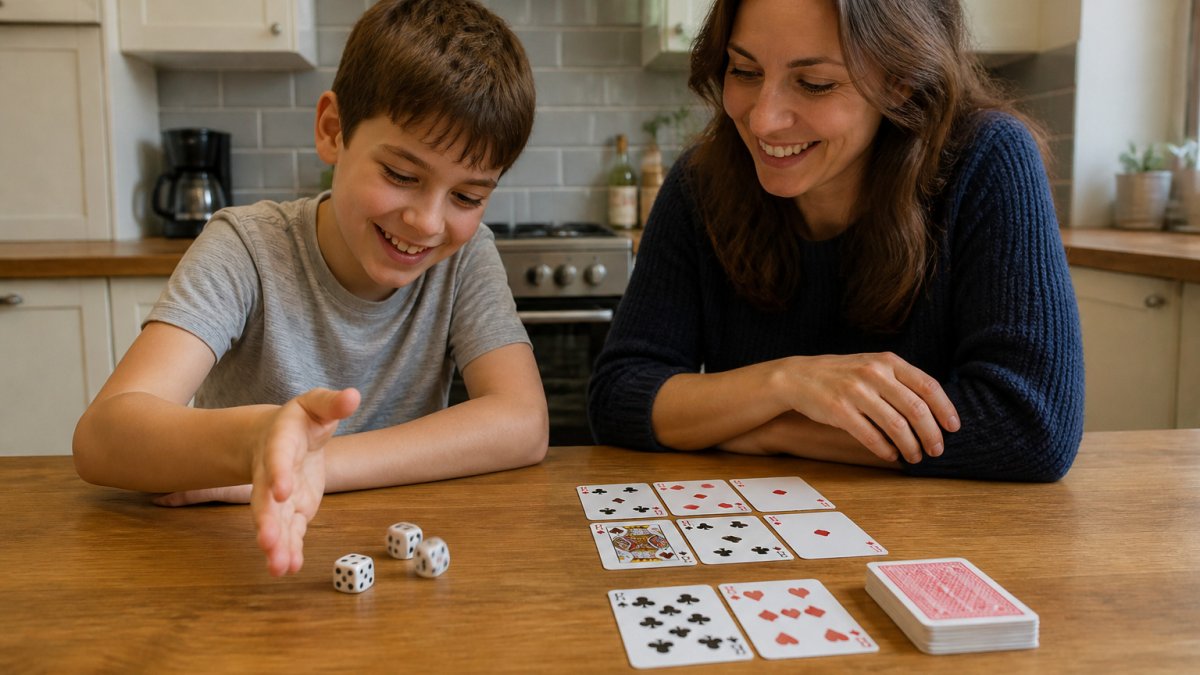
Dice totals: Each player rolls two dice and adds the numbers. The highest total wins the round. For a harder version, multiply the two numbers instead.
Card sums: Turn over two cards and add them. Take turns and allow time to explain or check the answer. Remove the picture cards for a simpler game.
Target game: Roll three dice and try to reach a target number, such as 20, using addition, subtraction or multiplication. This builds flexible thinking about numbers.
Keep the rules simple at first.
For a ready-made set of challenges, try Number Workshop, which offers 180 interactive challenges across addition, subtraction, multiplication, sharing and fractions.

Times Tables Games for 10-Year-Olds
Children can practise times tables through games.
Number Workshop - 180 Interactive Maths Challenges →
- Times table bingo: Write products on a grid and call out multiplication questions. Players mark the answers they hear.
- Race to 100: Players take turns rolling a die and multiplying by a number of their choice. The first to reach 100 exactly wins.
- Pass the answer: Take turns asking a multiplication question. Allow thinking time, and use counters or a drawing to check the answer together.
To practise mental calculation techniques, Maths Spark! offers 220 interactive learning cards across Easy, Medium and Hard levels.

Maths Activities for 10-Year-Olds Around the House
Everyday life offers plenty of chances to practise maths. Cooking, shopping and travel all involve numbers.
- Let your child work out the change when paying for shopping
- Ask them to halve or double a recipe
- Time a journey and work out the average speed together
- Measure rooms and estimate how much carpet or paint you need
Online Maths Games for KS2 and When to Use Them
Online maths games are one option for KS2 practice. Check the format before buying: an interactive digital resource uses a screen, while a paperback or physical card game can be used offline. Choose the format for the activity you want to do together.
Board and Strategy Games That Build Number Sense
The Alchemist's Numbers is a family card game for two to four players aged 10 and over. Players combine numbered Ingredient cards to reach a target. Its Advanced mode introduces multiplication and exact division.

Final Approach is a cooperative card game for one to five players aged 10 and over. Players work together as a flight-control team to guide aircraft through changing weather and crowded airspace. Everyone works from one shared control panel.
Choose Final Approach for: a shared flight-control challenge for ages 10+, played solo or with up to five people. Players use addition, subtraction and halving to plan aircraft movements. Check the rules and introductory mission to decide whether the challenge suits your family.
Making Maths Games a Regular Habit at Home
Choose one manageable activity and return to it when it fits your family. Let your child help choose the game, adjust the challenge and take a break when needed. Note which calculations they can explain and which need support.
Last Updated: November 1, 2026
Frequently Asked Questions
What maths games can a 10-year-old play at home?
Card games such as those involving adding, subtracting and making targets work well, as do dice games where children add or multiply the numbers they roll. Board games that involve money, shop-keeping or counting spaces also build number sense. Choose games that let your child explain their thinking. Quesbo's The Alchemist's Numbers (ages 10+) is a family card game that combines arithmetic with planning, and Final Approach (ages 10+) is a cooperative fast-maths game for one to five players.
How can I make maths fun for a 10-year-old?
Make it a game with a clear goal, a small prize or a points target. Let your child choose the game sometimes, and swap roles so they can set the questions. Digital practice can also feel fresh: Maths Spark! offers 220 mental maths trick cards across three levels, with narration and short missions, so children can practise without a timer hanging over them.
What are some screen-free maths games for children?
Try a dice race where each player rolls two dice, makes the largest number possible and adds it to a running total. Play Shop with coins or pasta pieces, where your child works out change and totals. Target games, where players aim to reach an exact number using cards, are another option. Board games that involve moving counters and keeping score can be played without screens.
How long should a child spend practising maths at home?
For a home practice session, you could choose a length that suits your child. Stop if frustration sets in, and finish on something your child can already do well.

