

Table of Contents
- Why Screen Free Activities for Kids Matter
- Indoor Activities for Kids That Keep Them Engaged
- Screen Free Activities for Toddlers and Younger Children
- Rainy Day Activities for Kids: Making Bad Weather Fun
- Ways to Reduce Screen Time for Children at Home
- Outdoor and Adventure Activities for Screen Free Play
- Family Games That Bring Everyone Together
- Educational Books and Learning Adventures
- Frequently Asked Questions
Last Updated: 16 October 2026
Why Screen Free Activities for Kids Matter
Notifications, tablets at dinner, the endless scroll before bed, screen time has become the default for children. But screen free activities for kids aren't about deprivation; they're about discovery.
Stepping away from screens builds confidence through hands-on challenges, develops reasoning no algorithm can teach, and sparks the creativity that leads to "Let's build something" instead of "What's next to watch?"
At Quesbo, we've spent years creating screen free activities for kids that feel like adventures, not alternatives. A child solving a puzzle experiences the satisfaction of their own problem-solving; a family playing together creates a shared memory that sticks.
The challenge isn't knowing screens are overused, it's finding activities that genuinely hold a child's attention without one. This guide covers practical screen free activities for kids across every age group and situation.
Indoor Activities for Kids That Keep Them Engaged
Indoor time doesn't mean bored time. The best screen free activities for kids indoors combine creativity with a clear outcome, something to make, solve, or achieve.
Craft Projects and Creative Making
Craft projects work because they're tactile and open-ended: a child follows instructions or invents their own path, and ends up with something made by their own hands.
Start with projects that have clear steps but room for personalisation. No-sew squishy crafts teach hand-eye coordination and creative problem-solving: a child traces shapes, cuts felt, layers decorations, and ends up with something they can make or gift.
Paper crafts, collage, and painting work equally well. Remove the pressure to create something "good", the process is the point, and a child absorbed in mixing colours isn't thinking about screens.
For ages 4-7, keep materials simple: paper, washable felt tips, child-safe scissors, glue sticks. For ages 8-12, introduce model-building or jewellery making to develop fine motor skills and patience.
Free printable craft guides are excellent starting points. Quesbo's Quesbie the Quest Pal Craft Guide offers simple, child-friendly instructions children can follow independently or with an adult, while the Quesbie, Oma & Ula Colouring Pack provides six A4 printable pages of lovable characters in playful scenes.

Strategy Games and Logic Puzzles
Logic puzzles and strategy games train the mind in ways screens rarely do, demanding sustained attention, pattern recognition, and decision-making under the good kind of pressure that builds confidence.
Puzzle books work well for independent play: sudoku, crosswords, and logic grids suit ages 8+, while younger children benefit from spot-the-difference, mazes, and matching games. Solving something independently is powerful motivation.
Strategy card and board games offer more social engagement. Tiny Empire teaches deduction and mental maths as players study customer clues, identify hidden shopping rules, and calculate payment and change, maths practice disguised as play. Galley Dash is cooperative: your family becomes a cabin crew collecting ingredients and preparing meals before time runs out.
The common mistake is choosing games that are too easy or too hard: if a game feels like homework it fails, and if it's too simple children lose interest.
Screen Free Activities for Toddlers and Younger Children
Toddlers and younger children (ages 2-6) need sensory-rich activities with minimal instruction. Their attention spans are short, but their curiosity is boundless.
Sensory play dominates this age group. Playdough, kinetic sand, water play, and texture exploration occupy young minds completely, provide safe, soft, washable, non-toxic materials and let them explore.
Building activities suit this age too. Soft blocks, wooden blocks, and magnetic tiles encourage spatial reasoning. A child stacking blocks and watching them tumble learns about balance and gravity through direct experience.
For ages 4-6, simple crafts work well: painting with chunky brushes, sticker activities, and playdough creations. Keep instructions minimal and materials abundant, the goal is exploration, not perfection.
Stories and picture books are essential: reading aloud builds language, imagination, and connection. For adventure-loving children, illustrated activity books like The Lost Map offer mystery and exploration, a free printable Quest Book for ages 8-12 that younger children also enjoy with adult guidance.

Colouring pages offer extended quiet time. The Quesbie, Oma & Ula Colouring Pack includes six A4 pages of familiar characters in fun scenes, recognition adds engagement beyond simple colouring.
Rainy Day Activities for Kids: Making Bad Weather Fun
Bad weather traps children indoors. Rainy day activities for kids need to fill hours without screens yet be simple enough to set up quickly.
Rotate activity types: start structured (a craft or game), move to something physical (indoor obstacle course or dance), then settle into something quieter (reading or puzzles). This rhythm prevents boredom and matches natural energy cycles.
Craft projects shine on rainy days: a 45-60 minute activity becomes an event rather than a distraction.
Building challenges work equally well. Set a goal: "Build the tallest tower" or "Create a bridge that holds a toy car." A clear objective maintains engagement.
Cooking or baking together transforms a rainy day into an adventure. Quesbo's Tasty Passport turns family cooking into a round-the-world journey: each destination includes three kid-friendly recipes, a first taste, a main meal, and a sweet finish.
Indoor scavenger hunts work for any age: hide small objects and give children a list. Use pictures for younger children and riddles for older ones ("I'm cold and keep food fresh. Find me in the kitchen.").
| Activity Type | Duration | Best Age | Setup Time |
|---|---|---|---|
| Craft projects | 30-60 mins | 4-12 | 5 mins |
| Building challenges | 20-45 mins | 3-12 | 5 mins |
| Cooking together | 60-90 mins | 5-12 | 10 mins |
| Scavenger hunts | 15-30 mins | 3-12 | 10 mins |
| Puzzle books | 20-60 mins | 6-12 | 0 mins |
| Story time | 15-30 mins | 2-8 | 0 mins |
Ways to Reduce Screen Time for Children at Home
Reducing screen time works best when it's not framed as restriction. Instead of "no screens," the approach is "yes to something better." This subtle shift changes how children experience the transition.
Identify screen time patterns: when do screens appear, after school, before bed, during meals? Once you see the pattern, replace it with an alternative that meets the same need.
The Lost Map – Free Printable Kids Adventure Activity Book | Ages 8–12 →
Involve children in planning.
Make family time screen-free. Designate specific hours, perhaps during meals or after dinner, when screens are off-limits for everyone.
Offer choice within boundaries. Instead of "No screens," try "You can play a game, do a craft, or read. What sounds good?" Children feel agency, and you've guided them toward a screen-free option.
Build anticipation. Talk up a new game or activity beforehand, "Tomorrow we're trying a new cooking adventure" creates excitement that competes with screen appeal.
Outdoor and Adventure Activities for Screen Free Play
Outdoor play is the ultimate screen free activity for kids. Fresh air, physical movement, and unstructured exploration occupy children completely.
Structured outdoor activities work better than open-ended "go play." Give children a mission: "Find five different leaves," "Build a den," "Create a nature scavenger hunt." A goal transforms outdoor time from vague to engaging.
Nature exploration suits all ages: younger children collect rocks, leaves, and sticks, while older children identify plants, observe insects, or track animal signs.
Outdoor games, tag, hide-and-seek, ball games, pavement chalking, require no equipment beyond imagination, yet are often overlooked in favour of organised sports or screens. A simple game of chase occupies children for hours.
Adventure books inspire outdoor play. Questbound Explore London and Explore the Thames are beautifully illustrated family guides that turn exploration into structured discovery: families follow the books to specific locations, complete observation challenges, and record photographs and memories.

Cooking outdoors, picnics, campfire meals, garden barbecues, combines food, nature, and social connection. If you're using Quesbo's Tasty Passport, prepare a recipe and eat it outside. The setting changes the experience entirely.
Family Games That Bring Everyone Together
Family games create shared memories individual activities can't. The best screen free activities for kids involve multiple generations playing together, talking, laughing, and enjoying mild competition.
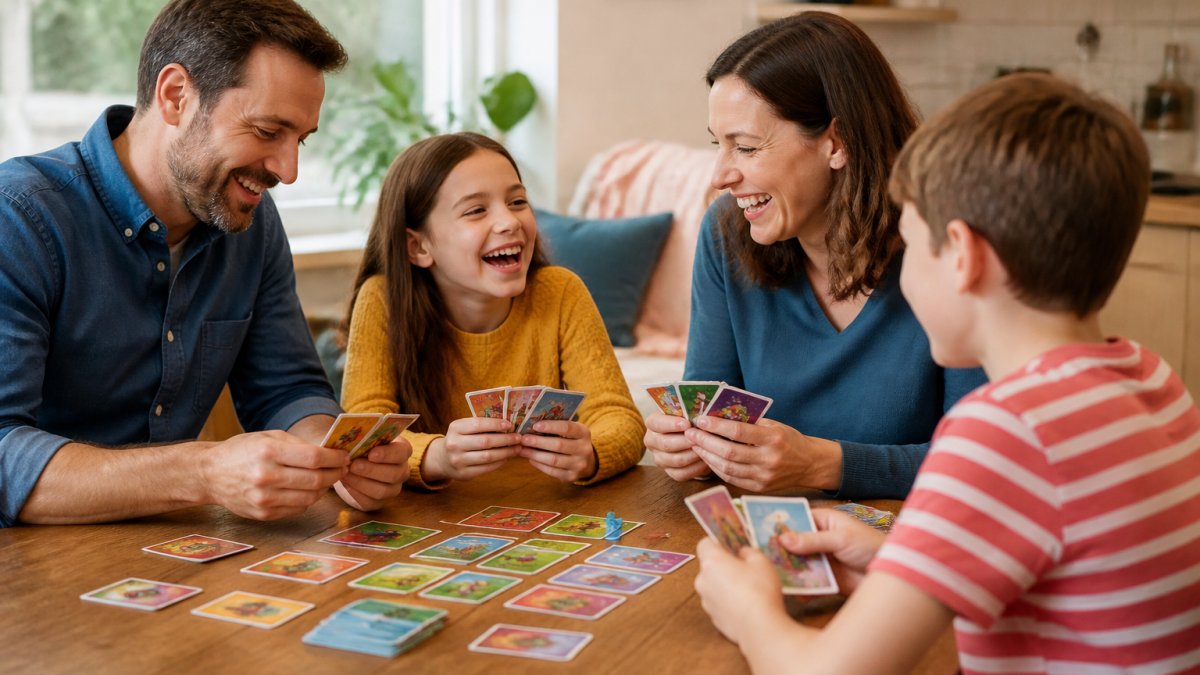
Tiny Empire and Galley Dash are designed specifically for family play.
Galley Dash is cooperative, your family works together as a cabin crew rather than competing. This removes the sting of losing and builds teamwork.
The key to family game nights is balancing challenge with enjoyment: too easy and engagement drops, too hard or too long and frustration builds.
Establish a routine. "Game night on Friday" becomes something children anticipate, and over time they associate family time with games rather than screens.
Include snacks and conversation. Games are the structure, but connection is the point. Pause between rounds to chat, laugh at near-misses, and celebrate wins.
Educational Books and Learning Adventures
Books remain the most powerful screen free activity for kids, developing imagination, vocabulary, and sustained attention at once. Yet many children need a reason to choose a book over a screen.
Illustrated adventure books suit children who find traditional novels intimidating.
Maths activity books like Questbound Fast Maths Adventure transform homework into genuine play.
Recipe books designed for children turn cooking into reading practice.
Free printable activity books like The Lost Map offer mystery and exploration: children complete 7 connected missions, solve puzzles and codes, and unlock a final secret password.
Match books to a child's interests: a child who loves animals will read an animal guide, and one fascinated by travel will engage with exploration books. Interest drives engagement far more effectively than age recommendations.
Reducing screen time works when the alternative is genuinely appealing.
Frequently Asked Questions
What are the best screen free activities for kids aged 8-12?
Screen free activities for kids this age work best when they combine fun with learning. Strategy card games like Tiny Empire develop logical thinking and mental maths. Activity books such as Questbound Fast Maths Adventure turn maths into adventures. Cooking projects, craft guides and family travel books keep minds active and hands busy. The key is choosing activities that match your child's interests, whether that's puzzles, creative making, reading or competitive games.
How can I encourage my child to spend less time on screens?
Ways to reduce screen time for children work best when you offer genuinely engaging alternatives rather than simply removing devices. Start by introducing activities your child actually enjoys, whether that's building things, solving puzzles or playing games with family. Set a consistent routine with screen-free times (like after school or during meals). Make these times appealing by having games, books and craft materials ready. Importantly, join in yourself. Children are far more likely to choose screen-free play when they see adults enjoying it too.
What can kids do indoors without screens on rainy days?
Rainy day activities for kids should be varied to keep boredom at bay. Free printable activity books like The Lost Map offer 7 connected missions with puzzles and codes. Craft projects using felt and foam keep hands occupied for hours. Cooking activities from books like Quesbo's Tasty Passport turn the kitchen into an adventure. Card games and board games work brilliantly on grey afternoons. Colouring packs, building projects and reading challenges all work well. The best approach is having a 'rainy day box' with several options ready to pull out.
Are screen free activities actually educational?
Yes. Screen free activities for kids build skills that screens often don't. Strategy games develop logical reasoning and problem-solving. Craft projects strengthen fine motor control and spatial awareness. Cooking teaches measurement, following instructions and food knowledge. Reading builds vocabulary and imagination. Activity books combining puzzles and challenges develop observation and persistence. Research shows children learn best through hands-on play and family interaction, exactly what these activities provide. The learning happens naturally through the fun of playing.
How do I know which activities will suit my child's age?
Indoor activities for kids should match their developmental stage and interests. Ages 5-7 enjoy simple crafts, colouring, and cooperative games with clear rules. Ages 8-12 engage with strategy games, more complex puzzles, and activity books with challenges. Most quality games and books clearly state recommended ages. Start with activities slightly below your child's age if they're new to screen-free play, success builds confidence. Mix different types: some solo activities, some family games, some creative projects.
