

Table of Contents
- Mathematics Games That Pull Children Away From Screens
- How to Pick Mathematics Games by Age and Ability
- Maths Games for Kids: Quick Card Games for Short Attention Spans
- Maths Board Games and Card Games That Reward Planning
- Maths Games to Play at Home: A Family Game Night Framework
- Screen-Free Maths Activities Beyond the Game Box
- Frequently Asked Questions
Last Updated: 12 October 2026
Mathematics Games That Pull Children Away From Screens
Mathematics games are structured play activities where numbers, patterns or calculations decide what happens next, so children practise arithmetic without it feeling like a worksheet. At Quesbo, we build ours around a simple rule: if the maths is the game, children stop noticing they are learning. The best picks for 2026 are card games and board games that fit a dinner table, a car journey or a rainy Sunday.
Here is the problem most families run into. A workbook gets finished under protest. A screen gets handed over because it buys quiet. Mathematics games sit in the middle: they hold attention because someone can win, and they build number confidence because every turn demands a calculation.
Below, we break down eight picks by age and ability, plus a framework for family game night that actually survives contact with tired children. Most guides list games without saying who they suit. We will tell you exactly which ages each one fits, and where each one falls short.
How to Pick Mathematics Games by Age and Ability
Match the game to the child, not to the box's age sticker alone. A seven-year-old who counts confidently will handle addition games aimed at older children, while a ten-year-old who panics at times tables needs a game with an easier mode, not an easier game.
Three things decide whether a maths game gets played twice or gathers dust:
- The maths must be the mechanic. If the sum is a separate question card bolted onto a board, children disengage. If the sum decides the move, they care about the answer.
- There must be a way to dial difficulty down. Look for games with three levels, a junior mode or a learning mode, so siblings of different ages can play together.
- Turns must not reward speed alone. Timed shouting suits a few children and stresses the rest.
National Curriculum maths programmes of study sets out what children cover in key stages 1 and 2, which is a useful check that a game's arithmetic sits near the right level. A game slightly below a child's school level builds confidence; one slightly above builds resilience. Two years above builds tears.
Ages 7 to 9: Building Number Confidence
Children at this stage need repetition without boredom, and visual support while they count. Look for games that use pictures alongside numerals, and that allow addition and subtraction as the main operations.
Number Quest suits this group well. It includes numeral cards and visual counting challenges, and its three difficulty levels mean a seven-year-old can start on the easiest setting while an older sibling plays the same round at a harder one. Players reveal a Target Card and race to build that exact number, which turns mental arithmetic into a puzzle rather than a test.

Tiny Empire, aimed at ages 8 and up, adds a different skill: deduction. Children study customer cards showing accepted and rejected baskets, work out the hidden shopping rule, then calculate payment and change. The money maths is genuinely useful, and the guessing element keeps it light.
Ages 10 to 12: Strategy and Mental Maths
Older children want to win on thinking, not just on knowing. This is where planning, bluffing and multi-step arithmetic come in.
The Alchemist's Numbers combines arithmetic with decision-making. Players gather numbered Ingredient cards and combine them to hit a Creation's exact target, then choose whether to claim now or save ingredients for a bigger score. The standard Family mode uses addition and subtraction; Advanced mode adds multiplication and exact division when players are ready.
For a cooperative twist, Final Approach puts everyone on one flight-control team guiding aircraft to their runways. Players add, subtract and halve values to manage altitude and speed, and the maths is woven into the mission rather than sitting in a separate question deck.
TURBO TWELVE! asks players to build a car whose part costs total exactly 12, then tune it by swapping parts while keeping the total. Addition and comparison happen constantly, and the takeover rule keeps siblings genuinely invested in each other's turns.
Maths Games for Kids: Quick Card Games for Short Attention Spans
Maths games for kids work best when a round finishes in under ten minutes. Short rounds mean a child who loses is still willing to play again, and a child who wins does not get bored waiting for the game to end.
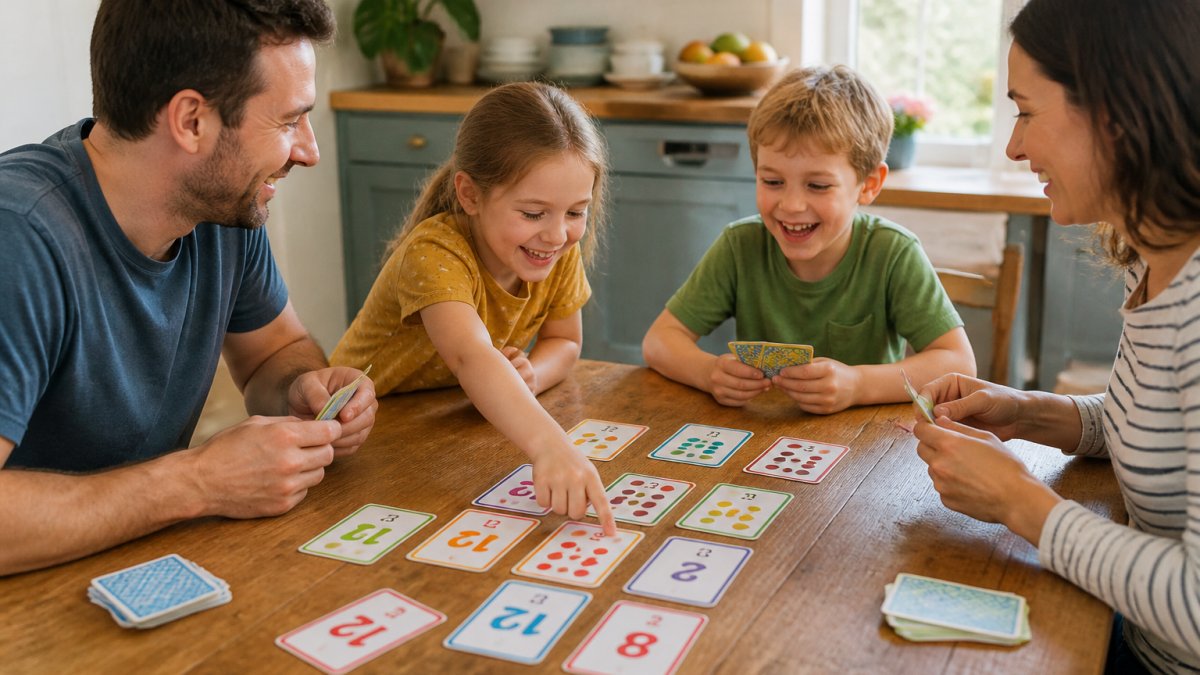
Card games beat board games here for a practical reason: setup takes seconds and there is nothing to knock over. Here is how the quick options compare.
| Game | Ages | Players | Round Length | Maths Focus |
|---|---|---|---|---|
| Number Quest | 7+ | 2-6 | Fast, timer-based | Addition, subtraction, doubling |
| Pattern Pirates | 10+ | 2-5 | Turn-based, no racing | Pattern recognition, sequences |
| Tiny Empire | 8+ | 2-5 | Six customer rounds | Addition, subtraction, change |
| TURBO TWELVE! | 10+ | 2-4 | Roughly 20-30 minutes | Addition to a fixed total |
Pattern Pirates deserves a note because it removes the pressure entirely. Players follow trails of shapes, shells, directions and creatures, then play the Discovery card that completes the pattern. There is no shouting and no race.
Maths Board Games and Card Games That Reward Planning
Maths board games and card games reward planning when the calculation feeds into a longer strategy rather than standing alone.
The Alchemist’s Numbers – Family Maths Card Game | Ages 10+ →

The Last Carriage is the clearest example. Players gather carriage cards, connect their shapes and add their numbers to match a journey's exact booking total. Then comes the bluff: the last carriage can be played face down with a claim about its contents, and the next player must decide whether to trust it or demand an inspection.
Final Approach takes the opposite approach to competition. Because it is cooperative, players discuss their calculations out loud. A parent can hear exactly where a child's number sense is wobbling, without ever asking a testing question.

The Alchemist's Numbers adds a mechanic worth mentioning: after each successful brew, one used Ingredient becomes the shared Echo, available to another player later. It softens the game for younger players and creates genuine table talk about whether to help or hoard.
Maths Games to Play at Home: A Family Game Night Framework
Maths games to play at home succeed or fail on the setup, not the game. A predictable routine removes the negotiation that otherwise eats the whole evening.
Try this structure:
- Pick a fixed slot. Same evening each week, thirty to forty-five minutes. Predictability does more work than enthusiasm.
- Choose one game in advance. Deciding at the table invites arguments. Announce it at breakfast.
- Start with a short round. Number Quest or Pattern Pirates first, to get everyone playing quickly.
- Move to one longer game. The Last Carriage or Final Approach, roughly 30-45 minutes.
- Let the youngest pick the mode. Junior or learning modes exist for a reason.
- Keep phones in another room. Not face down on the table. Another room.
- End while it is still fun. Stop one round earlier than the children want.
BBC Bitesize maths resources for parents is a useful companion for anyone who wants to check what a specific topic looks like at school level before choosing a game.
The honest limitation: this framework works when an adult plays too. Children treat a game as a screen substitute only if the adults are genuinely in it, not supervising from the sofa.
Screen-Free Maths Activities Beyond the Game Box
Screen-free maths activities fill the gaps between game nights, and they cost nothing. The trick is to make the maths incidental rather than announced.
Practical options that fit ordinary days:
- Shopping totals. Ask a child to estimate the basket before the till, then check the receipt.
- Recipe scaling. Doubling or halving quantities is fractions and multiplication in disguise.
- Journey planning. Distance, speed and time questions on a car trip, with the arrival time as the prize.
- Board game scoring. Let children keep the running score. Addition under mild pressure, with a purpose.
- A maths activity book. Questbound Fast Maths Adventure, for ages 8 to 12, turns practice into 15 themed missions with a final Grand Number Festival challenge. It suits the child who wants to work alone rather than compete, and covers place value, times tables, fractions, decimals, percentages and money problems.
Education Endowment Foundation guidance on parental engagement notes that how parents support learning at home matters more than how often. Short, low-pressure moments beat long sessions.
Family maths practice rarely fails because the games are wrong. It fails because the setup is too complicated, the difficulty is mismatched, or the adults are not really playing. Quesbo exists for exactly that gap: a family-run UK brand making original games and books where the maths is the mechanic, not a bolt-on. Our maths card games carry learning modes and difficulty levels so siblings can play together, our games are made in the UK, and our illustrated activity book gives children who prefer working alone a route in. Get started with Quesbo and turn a spare half hour into number confidence that lasts.
Frequently Asked Questions
What are the best mathematics games for children?
The best mathematics games match your child's age and confidence level. For ages 7 to 9, look for games with visual counting and simple addition, such as Number Quest, which includes picture-based values and three difficulty levels. For ages 10 and up, games like The Alchemist's Numbers add multiplication and division once players are ready. The key is choosing a game with adjustable difficulty so it grows with your child rather than sitting on a shelf.
How can I make maths fun at home without it feeling like homework?
The difference is context. Workbooks ask children to solve problems in isolation. Games like Tiny Empire or TURBO TWELVE! embed the maths inside a story or competition, so children calculate because the game requires it, not because an adult asked. Start with a game that uses addition and subtraction only, then introduce multiplication or division once your child is winning regularly. Short sessions of 20 to 30 minutes work better than long drills.
Which board games help children learn maths?
Strategy card games that require exact calculations tend to work best. Final Approach asks players to add, subtract and halve values while guiding aircraft to runways, so the maths directly controls what happens. The Last Carriage requires matching shapes and calculating exact totals to claim journeys. Pattern Pirates develops pattern recognition and sequencing, which underpin number work. Look for games where a wrong calculation has a visible consequence in the game, not just a wrong answer on a page.
What maths games can children play without a screen?
Card games are the easiest screen-free option because they need no power, no internet and pack away small. Number Quest, The Alchemist's Numbers and Pattern Pirates all play in 20 to 45 minutes with 2 to 6 players. The Questbound Fast Maths Adventure activity book offers screen-free practice for ages 8 to 12 through illustrated missions covering fractions, decimals and times tables. For travel, card games fit in a bag and work on trains or at a table in a café.
How do you choose a maths game for a child's age and ability?
Check the recommended age on the box, then look at the difficulty options inside. Number Quest suits ages 7 and up with three difficulty levels. Tiny Empire works for ages 8 and up with Starter, Standard and Challenge customer cards. The Alchemist's Numbers starts with addition and subtraction in Family mode, then adds multiplication and exact division in Advanced mode. If your child gets frustrated easily, pick a game with a cooperative mode, such as Final Approach, where everyone works together rather than competing.
