

Table of Contents
- Why Educational Toys Matter at Age 8
- STEM Toys for 8 Year Olds That Build Confidence
- Educational Board Games for 8 Year Olds
- Problem Solving Toys for Children
- Family Games for Children Aged 8
- Books and Adventure Resources for Independent Learning
- How to Choose the Right Toy for Your Child
- Frequently Asked Questions
Last Updated: 18 October 2026
Why Educational Toys Matter at Age 8
At age 8, children are ready for more sophisticated challenges. Their brains are developing rapidly, their confidence is growing, and they're beginning to think strategically about problems. This is the sweet spot where the best educational toys for 8 year olds in the UK stop being simple entertainment and become genuine tools for learning.
The difference between a toy that gathers dust and one that keeps children engaged comes down to one thing: does it feel like play, or does it feel like homework? The best educational toys for 8 year olds in the UK blur that line entirely. They're designed so that learning happens naturally through the excitement of playing, not through forced instruction.
At this age, children benefit from toys that develop reasoning, build confidence in maths and language, and encourage them to think independently. Screen-free play becomes even more valuable as competition for attention intensifies. Research shows that hands-on, interactive play strengthens problem-solving skills and builds the kind of confidence that transfers to school performance.
STEM Toys for 8 Year Olds That Build Confidence
STEM toys at this age shouldn't feel like a science lesson. They should feel like solving a puzzle or cracking a code. The best ones combine observation, logic, and practical problem-solving in ways that feel rewarding.
Deduction games are particularly powerful for 8-year-olds. They teach children to notice patterns, test hypotheses, and adjust their thinking based on evidence. This is real scientific thinking, wrapped in a game format. Tiny Empire (£49.99) is built on exactly this principle. Players run miniature shops and use customer clues to deduce hidden shopping rules, then calculate change and manage their till. It combines logical thinking, mental arithmetic, and tactical decision-making, all the components of mathematical reasoning that schools focus on, but delivered through gameplay rather than worksheets.

What makes Tiny Empire work is the difficulty progression. It includes three customer difficulty levels, so children aren't overwhelmed or bored. A child who struggles with pattern recognition gets to practise in a supportive way. One who finds it easy moves to harder challenges. This scaffolding is crucial at age 8, when confidence is still forming.
The game also teaches budgeting and money skills naturally. Children calculate payments and change as part of winning, not as a separate drill. This is how real learning happens, embedded in context, not extracted and isolated.
Educational Board Games for 8 Year Olds
Board games offer something tablets and screens cannot: they create shared moments. At age 8, children are beginning to understand strategy, negotiate with others, and handle winning and losing. Games designed for this age group teach these skills while building confidence in specific areas like maths, language, or problem-solving.
Games That Teach Maths and Logic
Maths-focused games work best when they make mental arithmetic feel like a challenge to overcome, not a chore to complete. Tiny Empire serves this purpose, but for children who want a different experience, Trail Quest: World Expeditions (£13.99) offers geography and strategy wrapped in an adventure format. Players race around the world, collect travel gear, and overcome obstacles. The game involves strategic card play and planning, not direct maths, but the kind of logical thinking that supports mathematical reasoning.

For children who want to focus more directly on maths confidence, a dedicated maths activity book like Questbound Fast Maths Adventure (£16.99) bridges the gap between games and independent learning. It's not a traditional workbook. Instead, it presents 15 themed maths missions guided by characters, with illustrated puzzles, shortcuts, and practical challenges. Topics include place value, addition and subtraction strategies, times tables, fractions, decimals, and percentages, the full range of what 8-year-olds encounter in school. The book is designed to make maths feel like an adventure rather than intimidating, with worked examples, varied difficulty levels, and a reference toolkit children can return to repeatedly.
| Game/Resource | Type | Focus | Best For | Price |
|---|---|---|---|---|
| Tiny Empire | Card Game | Deduction, Maths, Logic | Ages 8+ | £49.99 |
| Trail Quest: World Expeditions | Card Game | Strategy, Geography | Ages 8+ | £13.99 |
| Questbound Fast Maths Adventure | Activity Book | Maths Confidence | Ages 8-12 | £16.99 |
Games That Encourage Teamwork
Not every game needs to be competitive. Some of the most valuable learning happens when children work together toward a shared goal. Galley Dash! (£49.99) is a cooperative cooking card game where players become cabin crew on an aircraft. Together, they collect ingredients, prepare passenger orders, and deliver meals before time runs out. The game forces real communication and negotiation. Should one player start another dish or deliver one that's ready? How do you adjust when turbulence interrupts your plan?
Cooperative games teach children that sometimes the best move isn't the one that benefits you most, it's the one that benefits the team. This is a lesson that schools emphasise but that competitive games rarely reinforce. Galley Dash makes it fun to think as a group.
Problem Solving Toys for Children
Problem-solving skills are what separate children who freeze when faced with difficulty from those who approach challenges with curiosity. The best problem-solving toys present obstacles that feel achievable, hard enough to be interesting, easy enough to be possible.
Dream Chasers (£59.99) approaches problem-solving from an unexpected angle. It's a career-discovery game for ages 8-14 that turns exploration into a series of challenges. Players complete Challenge Cards that ask them to describe, explain, act, compare, imagine, and solve problems. The challenges progress through three difficulty levels: Starter (simple observations), Stretch (deeper thinking), and Big Break (connections and communication). This graduated difficulty means children practise problem-solving at their own level while gradually building confidence.

What makes Dream Chasers distinctive is that it's not about right or wrong answers. It's about thinking flexibly, communicating ideas, and discovering that problems often have multiple solutions. Children who struggle with traditional tests often flourish in this kind of environment because there's no single "correct" answer to defend.
The game also introduces children to many professions and the transferable skills each one requires, creativity, teamwork, communication, practical skills. This builds awareness that problem-solving matters in every career, not just in maths or science.
Family Games for Children Aged 8
The real power of educational toys emerges when families play together. Games that work for mixed ages and skill levels create moments where learning happens in conversation, not in isolation.
Tiny Empire – Family Deduction & Quick Maths Card Game | Ages 8+ →
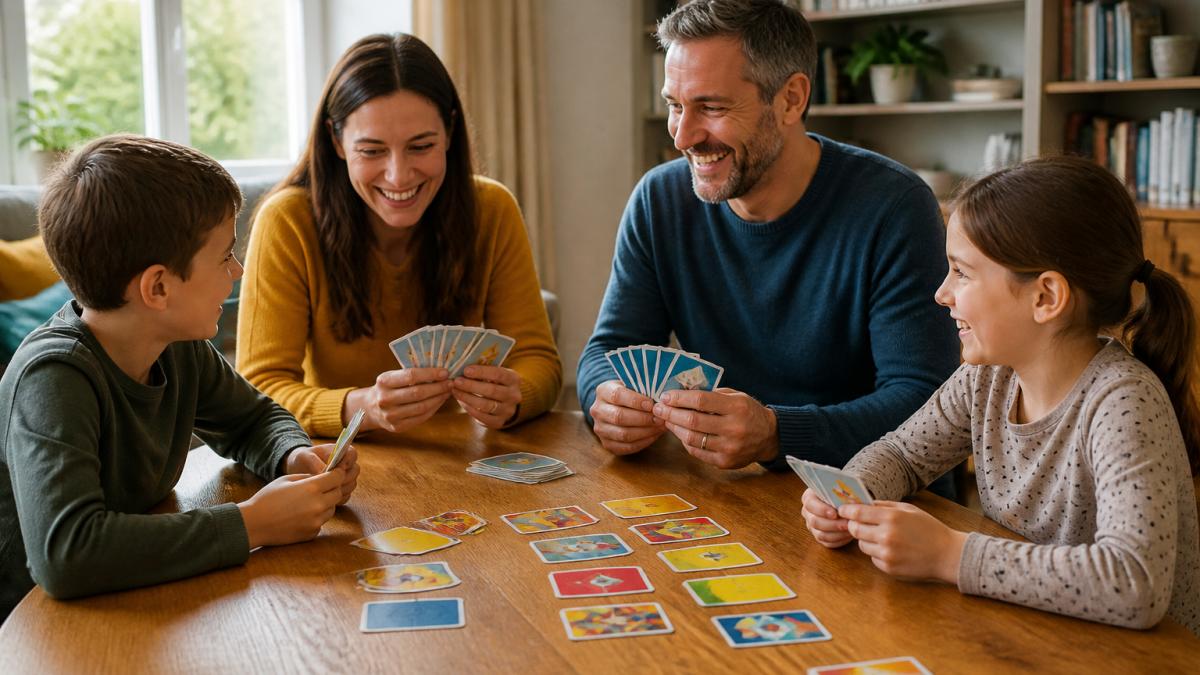
Galley Dash! works well for family game nights because it's cooperative and quick (25-35 minutes). No one is eliminated mid-game, so younger siblings don't get frustrated and leave. The theme, running an aircraft galley, is unusual enough to spark conversation and imagination. Parents often find themselves as engaged as children because the puzzle of resource management is genuinely interesting.
Trail Quest: World Expeditions is another strong family choice. It's faster than Galley Dash (easier to fit into a busy evening) and the travel theme appeals across ages. Children learn geography naturally as they race around the world. Parents who play often find themselves curious about destinations they hadn't considered.
For families where one child is much older or younger than 8, Dream Chasers handles age variation beautifully. The Starter Challenges work for younger children, while Big Break Challenges keep older siblings engaged. Everyone plays the same game but at their own level.
Books and Adventure Resources for Independent Learning
Not every child wants to play games with others. Some prefer to explore at their own pace, in their own way. Books and activity magazines designed for this age group can be just as educational as games, with the added benefit of building reading confidence and independent thinking.
Questbound Explore London (£23.99) is a beautifully illustrated family travel guide designed specifically for curious children aged 8+. Rather than simply telling children what to see, it encourages them to look closer, ask questions, and notice unexpected details. The book includes photo missions where children can add their own photographs after visiting, creating a personalised keepsake. This approach turns sightseeing into active learning. Children aren't passive tourists, they're investigators.
For children interested in geography and wildlife, Quesbo Explorer Magazine offers adventure-led learning without feeling like traditional workbooks. Issues cover destinations like Zimbabwe (Issue 3, £4.99), Arizona (Issues 4-5, £4.99 each), and Alaska (Issue 6, £4.99). Each magazine combines storytelling, puzzles, observation challenges, and hands-on activities. Children discover landscapes, wildlife, culture, and geography while developing reading comprehension, problem-solving, and critical thinking.
These resources work particularly well for children who are confident readers or who have specific interests (animals, travel, geography). They also offer screen-free entertainment for long journeys or rainy afternoons, something many parents desperately need.
How to Choose the Right Toy for Your Child
Not every educational toy works for every child. Age 8 is broad, a child who turned 8 last month is developmentally different from one approaching 9. The same applies to temperament. Some children love competitive games. Others find them stressful.
Start by observing what your child gravitates toward naturally. Does she spend hours building and solving puzzles? Does he prefer imaginative play and storytelling? Is she competitive or collaborative? Does he get frustrated easily or persist through difficulty?
For children who are already confident learners, choose toys with depth. Games with difficulty levels (like Tiny Empire's three customer levels or Dream Chasers' three challenge levels) prevent boredom.
Consider also how your child learns best. Visual learners often prefer illustrated books and games with clear visual information. Kinaesthetic learners benefit from games where they handle cards, move pieces, or physically interact.
Finally, think about your family's reality. If you rarely have time for family game nights, a cooperative game might not get used. If your child prefers solo activities, an independent resource like an activity book or magazine makes more sense.
Frequently Asked Questions
What makes educational toys different from regular toys for 8 year olds?
Educational toys are designed with specific learning outcomes in mind, whether that's developing maths skills, problem-solving ability or language confidence. They combine fun with discovery, so learning happens naturally through play rather than feeling like homework. The best educational toys for 8 year olds balance challenge with achievability, keeping children engaged without frustration.
How do STEM toys for 8 year olds help with school subjects?
STEM toys develop logical thinking, pattern recognition and practical maths skills that directly support what children learn at school. Games involving deduction, strategy and calculation strengthen mental arithmetic and reasoning. These toys help children see maths and problem-solving as enjoyable rather than intimidating, building confidence they can carry into the classroom.
Are screen-free educational toys really better than apps or digital games?
Screen-free toys offer benefits apps cannot: they encourage face-to-face interaction, develop fine motor skills through handling cards and pieces, and allow children to set their own pace without time pressure or notifications. Family games and board games create shared moments where conversation and teamwork happen naturally. Many children benefit from a mix, but screen-free time strengthens independence and imagination.
How do I know if a game or toy is the right difficulty level for my 8 year old?
Look for toys with adjustable difficulty levels or multiple challenge modes. Games with 'starter', 'standard' and 'challenge' options let children progress at their own pace. The best educational toys for 8 year olds should feel achievable at first, then offer ways to stretch thinking as confidence grows. If a toy feels too easy or frustrating, it's less likely to hold engagement.
At Quesbo, we've designed our collection around this principle: the best educational toy is one that children genuinely want to play with again. Whether it's a game that builds maths confidence, a book that sparks curiosity about distant places, or a cooperative challenge that brings families together, the learning happens because play comes first. Add one to your collection and watch how quickly it becomes part of your family's routine.
